





October is Fire Safety Awareness Month
As moms, we have plenty to worry about. You make sure your children are receiving appropriate medical care, that they are exposed to stimulating learning environments, that they have the right size clothes, and you track their nutritional intake like a champ. When it comes to fire safety though, is teaching them “Stop, drop, and roll!” really enough?
As a firefighter’s wife, I can confirm that there is much more to consider when it comes to planning for your family’s safety in the event of a fire. So, in honor of Fire Safety Awareness Month this year, I wanted to share some tips, tricks, and local resources that can help you with your family’s fire safety plan.
Step 1: Check those smoke detectors!
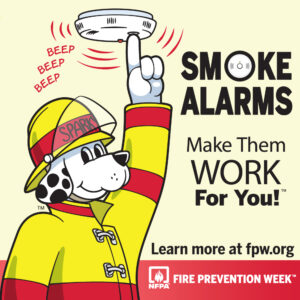
Having a working smoke detector (or detectors depending on the size of your home) is the number 1 recommendation for fire safety. I’ll be honest, I’m just as annoyed as the next person when that chirp of the battery alarm inevitably goes off right at bedtime. As tempting as it is to pull a Phoebe and smash it into oblivion, know that that tiny device is your first line of defense when it comes to making it out in the event of a house fire. Most fire departments recommend that you test your smoke detector once a month and that you replace the batteries when the time changes in the fall and spring.
If you don’t have a working smoke detector in your home, you can pick one up at any hardware store or add it to your cart on Amazon. The Alabama Fire College also has a program called Get Alarmed Alabama that can help you get a smoke detector at no cost.
Step 2: Have a well placed fire extinguisher handy.
Like many of you, we have always had a fire extinguisher in our kitchen. When I was growing up, it was under the kitchen sink at my parents’ house. In our current house, it’s in a bench in the kitchen. But, did you know there are different types of extinguishers for different materials? Since a fire extinguisher can effectively put out 80% of fires, it’s important to make sure you’ve got the type that will work for you.
Once you’ve purchased and stored the correct type of extinguisher for your home, make sure you know how to use it! You don’t want to get caught trying to learn to use it in the moment where you actually need it. So, just remember to P.A.S.S.:
And, on a personal note, make sure your fire extinguisher has not expired. When my husband was completing the fire academy, he decided to check the extinguisher in my parents’ home. My parents were equal parts embarrassed and horrified that their extinguisher had expired more than a decade before he checked. Thankfully, they never needed it, but it’s since become a running joke in our family.
Step 3: Create an evacuation plan.
You don’t want to wait until you need it to figure out how you’re getting everyone out of the house. I’ll be honest, when my husband first suggested we discuss our plan with our four-year-old, I thought he was being a little extra. My plan was to grab our son and the dog and get out of the house. (I’m guessing that’s the plan a lot of moms have established as well.) However, when children are old enough to independently play in other parts of the house, you need to communicate the plan with them, too!
Have a designated place to meet in case you need to evacuate the house. We chose a specific spot in our neighbor’s yard where it would be easy for me to see if everyone is out. We have taught our son which windows can open if he needs to get out a window and we have discussed which rooms he would need to stay in and wait for the fire department to come help. In a multistory home, it is important to teach them that sometimes they need to open a window and wait where they are!
The Red Cross has created a tool that can help you come up with your family’s Home Fire Escape Plan that your kids can help with, too!
Step 4: Close before you doze.
This is the one that moms often have the most trouble with. After a decade of research, the Fire Safety Research Institute (FSRI) determined that a closed door during a home fire can make a difference of up to 900 degrees between two rooms! (No, that’s not a typo.) The FSRI used thermal imaging cameras that showed that a house fire can reach 1000+ degrees. However, when they tested the spread of a fire through a house, they found a room with a closed door would read as less than 100 degrees on average, even if an adjacent room was registering 1000+ degrees on the other side of the door.
Even though I knew we were supposed to close our doors to our bedrooms at night, it was hard to bring myself to close my door at night. Our son’s nursery was just down the hall, but, let’s be honest, I trust myself more than I trust the baby monitor. I wanted to know I could hear him in the middle of the night if I needed to! It wasn’t until one of my husband’s coworkers posted this Close Before You Doze Video that I completely changed my mind. Take the time to watch that video, mamas. You will be shocked at how quickly a fire can spread through your home and the drastic difference that closing your doors can make!
Local Fire Safety Events
Most of our local fire departments schedule visits to local daycares and elementary schools during the month of October. So, your child may come home with a new fire helmet, stickers, or coloring sheets in the next few weeks. However, if your child is super interested in meeting some real-life firefighters, check out these upcoming local events:
- Pelham’s National Night Out on Tuesday, October 1st from 6:00-8:00.
- Leeds is hosting a National Night Out on Tuesday, October 1st, from 5:00-8:00.
- Vestavia Hills is having a Community Night Out and Fall Festival on Thursday, October 3rd from 5:00-7:00.
There are also resources for teachers available with free materials for fire safety units.